Copyright and Ownership Risks Tied to AI Content Provenance
Companies risk owning nothing if their content is entirely AI-generated.
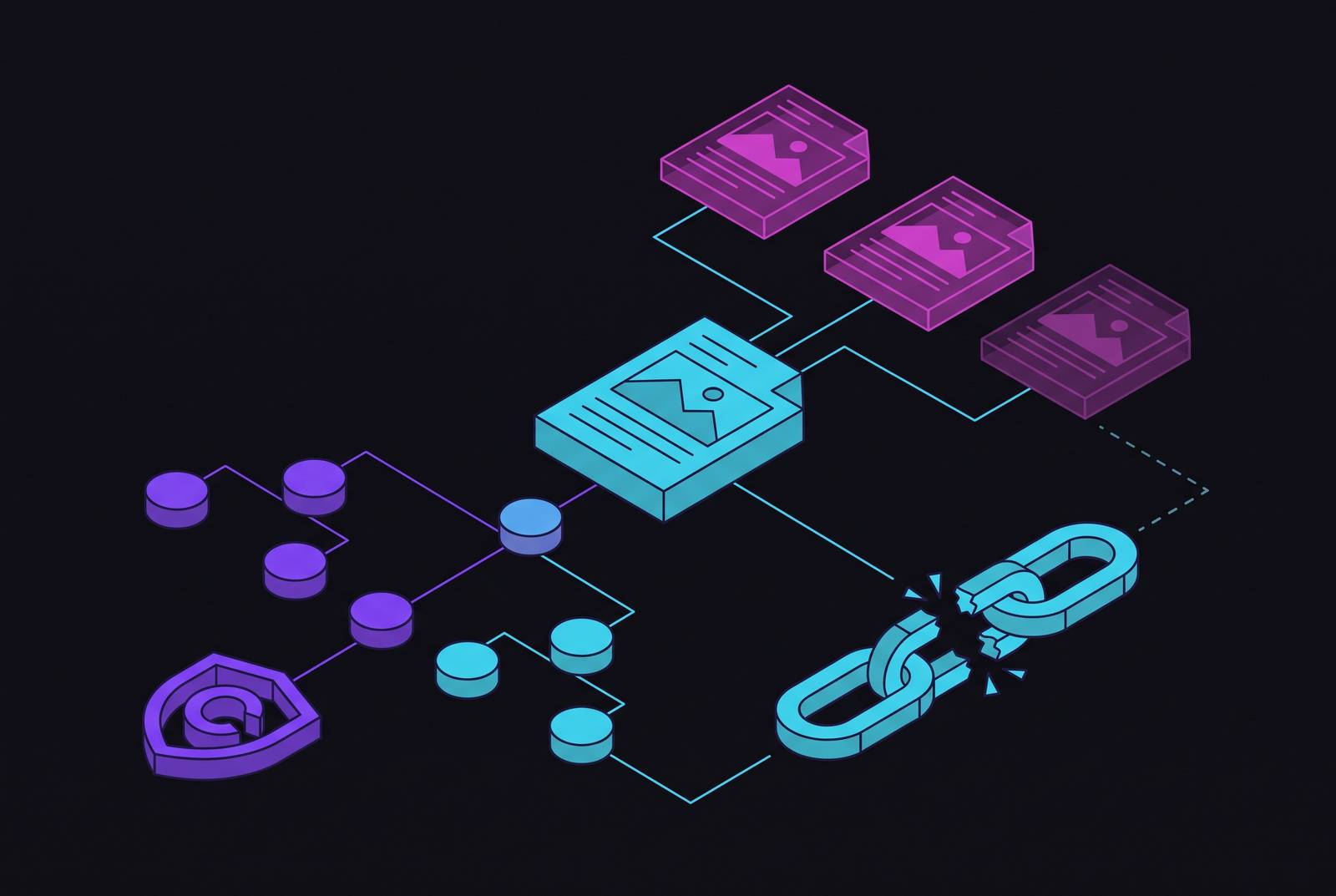
U.S. copyright law has one unbending requirement: a human author. Fully AI-generated content fails that test, and the failure means organizations have no legal title to the marketing copy, white papers, and other assets their teams are now producing at scale. The U.S. Copyright Office made this explicit on January 29, 2025: a prompt alone does not make AI output copyrightable, and human creative expression has to be present in the final work for protection to attach. The Supreme Court closed off the last realistic challenge to that rule in March 2026, declining to hear Thaler v. Perlmutter. That decision shuts the main appellate door on AI authorship claims and locks the current rule in place for the foreseeable future.
The consequences run deeper than any single piece of content. An organization whose content library is substantially AI-generated may find that it owns nothing in that library worth defending in court, worth licensing to a partner, or worth counting as an asset in a valuation. And because no one holds the copyright, the vacuum cuts in both directions: a competitor who independently generates output substantially similar to an organization's own work faces no infringement exposure, since neither party has a legal claim to assert against the other. It is a structural deficit underlying every asset a company publishes, caused by the absence of legal title described above, and it sets the terms for every argument that follows in this piece.
How AI content use is outpacing the legal framework
The pace at which AI-generated content enters commercial publishing has far outrun the legal infrastructure designed to attribute, license, or adjudicate it. Researchers studying large language model watermarking describe this as part of a broader pattern: copyright, privacy, and security have become urgent subjects of study because LLM output now appears across a huge range of writing tasks, content creation chief among them.
The numbers show how far the practice has already outrun the rules. The 2026 CCC/Outsell Copyrighted Content Usage Trends Report finds that unlicensed content sharing, in its traditional form, has reached four times its 2016 level, and AI adds a second layer on top of that older problem, one that moves faster than the first ever did. Half of knowledge workers surveyed already have externally published content flowing into AI systems through automated feeds and APIs. Content enters these systems without the case-by-case review that might once have caught a licensing problem before it became one. The pattern at the top of organizations makes the exposure worse rather than better: senior executives, the people most likely to know the licensing policy, are also the people most likely to share content with AI systems without following it, which puts the liability at the level of the decision-makers rather than at the level of junior staff making isolated mistakes.
None of this is accidental. Organizations are accumulating legal exposure faster than their compliance teams can track it, and the only tool capable of reconstructing what happened after the fact is provenance: a record of what was generated, by which system, and under whose direction. Everything in the sections that follow concerns what that record can and cannot do.
What regulatory enforcement requires content teams to prove
Regulators in the U.S. and EU have moved from guidance to enforcement, and the obligations they impose all converge on a single demand: organizations must be able to demonstrate the provenance of their AI-generated content. California's SB 942 took effect on August 2, 2026, setting disclosure requirements for AI-generated content used in commercial settings. The EU AI Act's Article 50 enforcement began that same month, and the penalties attached to it are not symbolic: violations carry fines of up to 3% of a company's global annual revenue.
Starting in 2026, AI providers operating in Europe have to publish summaries of their training data, honor copyright opt-outs, and label certain AI-generated content, including deepfakes and AI-generated text on matters of public interest, as artificial. Older models face a separate, dated obligation: they must adopt the C2PA text-watermarking approach before the EU's grace period ends on December 2, 2026, a hard deadline that applies to content already moving through production pipelines today, not just to future output.
Litigation has so far concentrated on the model builders rather than the people using their tools. All 70-plus active AI copyright lawsuits tracked in 2026 name AI developers as defendants, not end users. But that pattern narrows, rather than removes, the risk facing content teams. A user's exposure rises sharply the moment an organization prompts a model specifically to reproduce protected work, or publishes output that turns out to be substantially similar to material already under copyright. In either scenario, the only evidence an organization can point to, showing what was generated, how, and under what instruction, is the provenance record created at the moment of generation. Once a liability question reaches the content team, that record is the only contemporaneous account of intent and process available, and nothing created after the fact can substitute for it.
How statistical watermarks establish AI content provenance
Token-level statistical watermarks are the main technical tool AI labs use to embed a traceable provenance signal directly into generated text, and the next section examines the mechanism in detail before turning to where it fails. The dominant method, known as KGW, works at the level of individual word choices rather than at the level of hidden characters or file metadata. At each step of generation, the model hashes the tokens that came before using a secret key, and that hash splits the vocabulary into two groups: a green list and a red list. The model then adds a small bias, δ, to the scores of every green-list token, so that watermarked text ends up using green-list words more often than plain chance would produce.
Detecting the watermark means counting how many green-list tokens actually showed up and comparing that count to what randomness alone would predict, using a z-score: Z = (|s|_G − γT) / √(Tγ(1−γ)). Text gets flagged as watermarked once that score crosses a set threshold. Because the signal accumulates one token at a time, it grows stronger as a document grows longer, and short pieces of text rarely contain enough tokens for the detector to reach a confident result. That limitation matters for any content team dealing in short-form copy, headlines, or snippets, where the text may not be long enough to carry a detectable signal.
Real-world documents rarely consist of pure, start-to-finish AI output, and standard detectors struggle when a watermark is confined to only part of a document. A tool called WaterSeeker addresses that gap directly: rather than assuming an entire document is watermarked, it first locates the likely watermarked segment and only then runs detection on that segment, recovering signals that full-text detection methods miss entirely. A related technique, signature filtering, removes a learned set of statistically disruptive tokens before running the detection test, which raises detection rates in weak-signal and low-entropy cases from very low baselines to a range of 78 to 99 percent once filtering is applied.
KGW is not the only family of approaches in use. The Aar family guides token sampling with pseudo-random sequences instead of biasing logits directly, and sentence-level methods embed signals at the level of meaning rather than individual word choice, aiming for more robustness against paraphrasing. Every version of this technology runs into the same trade-off: a larger bias δ makes the watermark stronger and easier to detect, but it also distorts the text more. Stronger provenance, in other words, comes at a real and measurable cost to the quality of what gets published, and no operator running these systems can escape that trade-off.
Where token-level watermarks break down as provenance instruments
The properties that make a token-level watermark detectable are the same properties that make it attackable, and attack is not even the primary threat. Several categories of routine content operations are sufficient to destroy or obscure a provenance signal without any adversarial intent.
The clearest demonstration of deliberate evasion is an attack called BIRA, developed by Hwang, Park, and Ok at POSTECH. BIRA requires no queries to the original model. It applies a negative logit bias to a proxy set of tokens identified through token surprisal, and in testing it drove a text's z-score down from 6.03 to 0.83, well under any standard detection threshold, while preserving the meaning of the text substantially better than earlier evasion methods managed. Evasion rates under BIRA are near-total across a range of different watermarking schemes. The theoretical mechanism behind that result explains why the signal is so brittle: lowering the average probability of sampling a green-list token by even a small amount causes the probability of detection to decay exponentially, not gradually. The provenance signal, in other words, is far more fragile than its apparent strength suggests. Even more robust, position-randomized variants of watermarking remain vulnerable to bias-adaptive attacks that cut the true positive rate sharply while leaving the text's usefulness largely intact.
None of this requires an adversary. Fine-tuning a model on new data effectively erases output-space watermarks on its own. Quantization, a standard step in deploying models efficiently, breaks fingerprinting. Ordinary platform operations, screenshots, document exports, and CMS processing, strip or overwrite the signal as a byproduct of normal publishing workflows, with no intent to evade anything. KGW-style watermarking also runs into structural trouble in low-entropy text, in paraphrased text, and in cross-lingual content, which describes a large share of what multilingual enterprise content pipelines produce every day.
The fragility is not confined to text. In speech generation, research from Redwing shows that retokenization, the process of decoding generated audio into a waveform and re-encoding it, changes the underlying token identities and erodes a token-level watermark in the process. After eight consecutive rounds of this resynthesis, KGW detection fell to just 8.3% true positive rate at a low false-positive threshold. That result illustrates something broader than a speech-specific problem: routine platform re-encoding, the kind that happens constantly and without any adversarial intent, can destroy a provenance signal on its own. The underlying weakness is a structural property of token-level watermarking generally, not a defect unique to one modality, and text remains the primary concern for the compliance questions this piece is built around.
Why C2PA leaves text largely unprotected
The industry's most developed provenance framework is C2PA, which has achieved broad adoption across images and video, built through years of coordinated work among major technology companies. What it has not yet done is extend that same protection to text, which happens to be the asset class carrying the most acute copyright risk and the most active litigation.
C2PA 2.1, ratified in 2025 and now recognized as ISO/IEC 22144, defines a Content Credentials manifest: a signed container, built on a JUMBF-based format with CBOR-encoded claims and COSE digital signatures, bound to a file and recording which device or model produced it, every edit made to it, and a full cryptographic chain of signatures. Adoption has moved quickly. Thousands of organizations have joined the Content Authenticity Initiative, hardware makers ship devices with C2PA built in, and major platforms now display Content Credentials directly to users. On May 19, 2026, OpenAI joined C2PA and added SynthID watermarks to every image generated by ChatGPT, Codex, and its API, and Google announced native C2PA and SynthID detection in Search and Chrome on that same day. TikTok has labeled more than 1.3 billion AI-generated videos using the standard. Adobe, responding to regulatory pressure from the EU, removed the option to disable Content Credentials for any workflow that touches generative AI features.
The gap sits precisely where text lives. C2PA 2.1 covers images, video, and audio, but standardized text watermarking at production scale is only now taking shape, and older models have to adopt the C2PA text-watermarking approach before the EU's grace period ends on December 2, 2026. Even where C2PA metadata does exist on covered media, ordinary uploads, screenshots, exports, and platform transformations frequently strip or break it. Even for the formats C2PA was built to protect, provenance functions as a signal rather than as proof. The practical consequence lands exactly where the legal risk is highest: articles, white papers, ad copy, and product descriptions, the asset types most likely to trigger copyright exposure, are the ones with the thinnest provenance infrastructure currently protecting them.
How multi-model content pipelines compound the provenance chain problem
A single watermark is fragile enough on its own. Enterprise content architecture makes the problem worse, because provenance in a multi-model pipeline is not simply weak, it is broken by design at every hand-off between systems.
The standard enterprise setup in 2026 is a cascaded pipeline: a drafting LLM produces a first version of a piece, a rewriting agent reshapes it, and a publishing CMS processes it before it goes live, with no continuous record connecting those three stages. The same structure appears in audio production, where audio enters a speech-to-text model, passes through a language model, and exits through a text-to-speech model, with three separate vendors producing three separate points where evaluation has to happen independently. The written-content case follows the identical logic. At each hand-off, the receiving model can strip or overwrite whatever watermark or metadata the prior model embedded, so the content that finally reaches a publisher may carry no recoverable trace of how it was originally generated. Tracking the provenance of the material each model in the chain is working with has stopped being a technical nicety and become a critical legal requirement.
One technical approach addresses part of this at the model level rather than the pipeline level. That result is strong, but it only helps organizations that train or fine-tune their own models. It offers nothing to teams building on third-party APIs, which describes most enterprise content operations. A separate vulnerability affects fingerprinting methods generally: attackers can automatically filter out high-perplexity fingerprint queries, defeating most fingerprinting approaches that rely on intrinsic signals or adversarial suffixes, and only methods whose fingerprint queries look statistically ordinary manage to resist that filtering.
The same architecture that breaks provenance also breaks brand voice. The two problems, quality consistency and provenance tracking, turn out to be the same architectural problem wearing different names.
What dispersed multi-model authorship does to the provenance signal
Genuine multi-model authorship, blending token-level output from several different providers rather than passing a draft sequentially through them, scatters the statistical signature that a single-model pipeline would otherwise leave intact. That scattering changes both how detectable a piece of content is and what an organization can credibly claim about where it came from.
A single model writing on its own leaves a consistent, repeatable statistical fingerprint running through every sentence: the same green-token distribution, the same logit bias pattern, the same z-score profile from start to finish. That consistency is what KGW-family detectors are built to find, and it disappears once output is blended at the token level across models from different providers. No single model's watermark dominates the resulting sequence. What a detector sees instead is a mixture distribution, a blend of signals rather than one clean signature, and that blend does not resolve into a usable provenance claim for any individual system in the chain.
For compliance purposes, that outcome cuts two ways at once. It undermines the clean, single-source attribution that content teams might want to produce, since a blended document cannot point to one model as its author in the way a watermark detector expects. It also means that no single company's model watermark can be isolated and used to pin infringement liability onto one specific system or one specific vendor. This matters directly for the question of who owns this content: if no model's signal dominates, and no human author stands behind the combined text either, the content occupies the same ownership vacuum as before, now with a provenance trail that is harder to reconstruct after the fact.
Sources
- Watermarking with Low-Entropy POS-Guided Token ...
- WaterSeeker: Pioneering Efficient Detection of Watermarked Segments in Large Documents
- Signature filtering: a lightweight enhancement for statistical watermark detection in large language models
- Tokens Change, Structure Endures:Spectral Watermarking for Generated Speech
- Growth in Enterprise AI Adoption is Driving Copyright Risk
- Growth in Enterprise AI Adoption is Driving Copyright Risk, According to New Study from CCC and Outsell
- US Supreme Court Declines to Consider Whether AI Alone Can Create Copyrighted Works
- LLM Watermark Evasion via Bias Inversion