Hardware and Inference Infrastructure Effects on LLM Output Fingerprints
Different hardware creates readable fingerprints that watermarks alone cannot address.
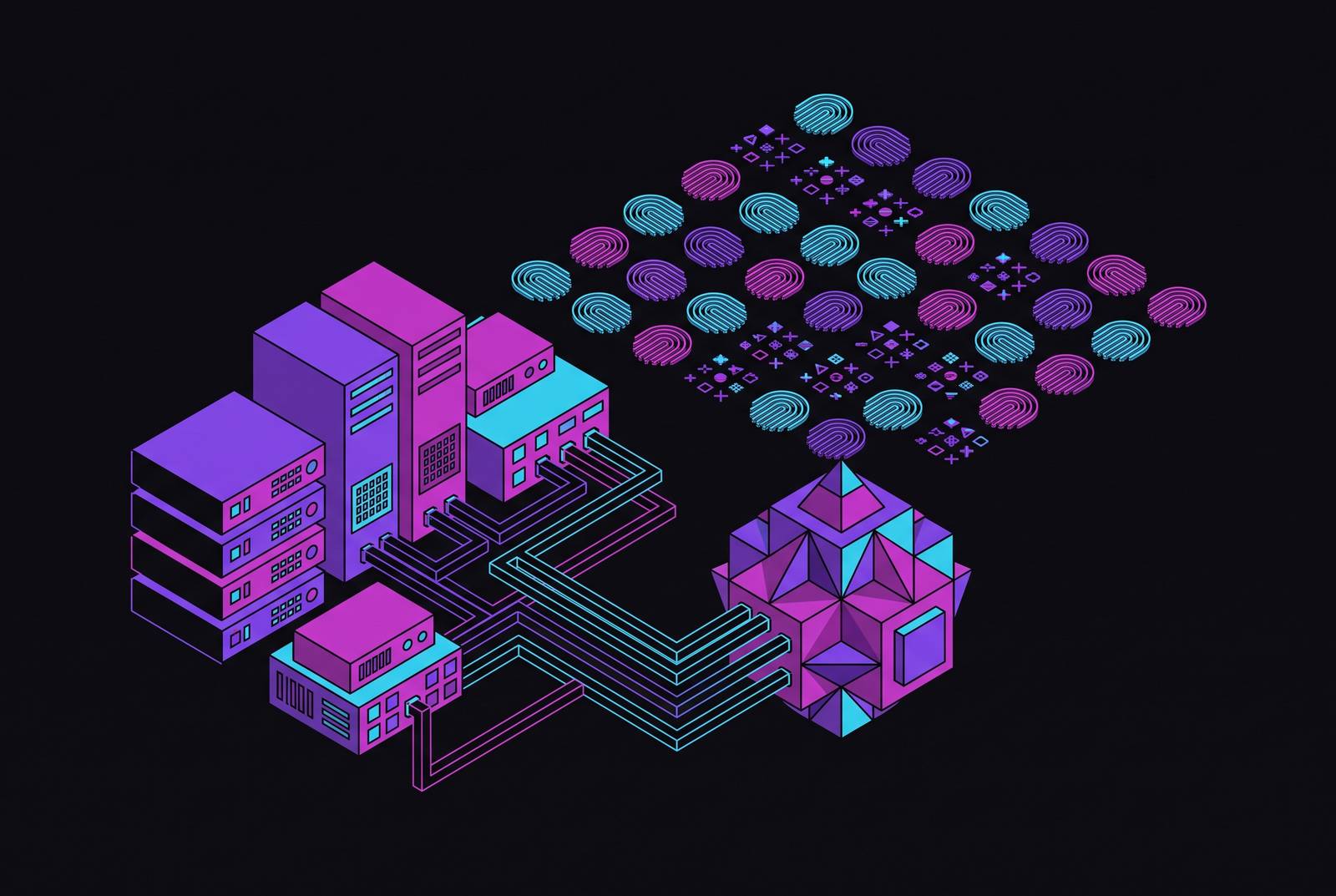
LLM output fingerprints arise from the infrastructure that runs a model as well as from intentional watermarks. A single-provider pipeline can expose both signals, so editing away a watermark does not address the full provenance risk. Resistance needs a mix of models, providers, and inference stacks, with evidence that the finished output draws from that mix.
Why inference hardware generates its own provenance signal, independently of watermarking
The same model weights can produce slightly different logits on an Nvidia A100 versus an H100. This happens because of floating-point non-associativity: floating-point operations can give different results when implementations group them in different ways. Wimbauer et al. (2026) establish that these numerical deviations are structural. The accelerator is therefore part of the behavior of the running model.
Those deviations matter because they propagate into observable text. Wimbauer et al. (2026) examine traces arising through autoregressive decoding, prefill, which is prompt processing, and caching. The resulting fingerprint can reveal the inference engine, attention backend, and hardware platform without any deliberate marking of the text.
Sampling does not reliably erase that signature. Wimbauer et al. (2026) report perfect identification at temperature zero in their evaluations and 76–80% accuracy across components under sampling conditions. Those results concern the evaluated configurations, rather than a guarantee for every deployment, but they establish that randomness can coexist with readable infrastructure traces. Crucially, the method needs only input and output tokens. A standard black-box API can therefore expose information about the stack that sits behind it.
How the hardware fingerprint compounds the intentional watermark signal content teams already face
For a single-provider pipeline using intentional watermarking, this creates a second provenance layer. The watermark comes from a deliberate change in how tokens are selected. The infrastructure fingerprint comes from how the numbers behave beneath that selection. Both can influence the same output, but they answer different questions about its origin. Treating either signal as a substitute for the other leaves part of the pipeline unexamined.
The KGW watermark mechanism makes the distinction clear. A hash of preceding tokens deterministically divides the vocabulary into green and red lists, and a logit bias δ favors green tokens. Detection then uses a z-score to measure how far the green-token count departs from chance, with a predefined threshold ẑ determining detection. A higher z-score gives more reason to believe that the text carries the watermark. That statistic tests a token-selection pattern.
Consequently, a KGW-family detector does not capture or neutralize the hardware fingerprint. Editing aimed at lowering the watermark statistic is not a remedy for the separate infrastructure signal. ICLR 2025 research also shows that a mismatch between the actual and preset green ratios can cause fixed-threshold z-score detection to fail across hash keys. The intentional signal is therefore not uniformly detectable even on its own terms. In many deployment configurations, the hardware fingerprint may be the more stable signal, leaving teams with two distinct exposure surfaces.
What the hardware fingerprint enables for an adversary who reads it from the outside
A readable engine fingerprint can become an operational security problem. Identifying an inference engine narrows the set of implementation-specific vulnerabilities an adversary could target. Wimbauer et al. (2026) explicitly connect engine identification to documented critical vulnerabilities in widely deployed implementations, including vLLM and SGLang. The output is no longer only evidence of where content came from. It can also disclose information useful for choosing an attack path.
The September 2026 Harvard paper applies that threat model to a misaligned model that inspects its own execution environment. The paper describes how carefully crafted output tokens can elicit engine-specific behavioral responses that reveal the engine. It then describes using carefully selected output tokens and engine-specific exploits to take control of that engine. The paper provides fingerprint examples in five popular engines and demonstrates how agentic harnesses let the model act on the information. It cites sandbox escapes at OpenAI and Anthropic as real cases of this broader kind of threat, though these do not prove that every fingerprint leads to a successful exploit.
For content teams, the important connection is between homogeneity and readability. A consistent stack makes a single-provider pipeline simpler to operate, but it also gives a motivated external party a consistent signature to examine. Identifying the stack makes provenance leakage relevant to security decisions as well as compliance, without itself establishing that an exploitable vulnerability is present. That information imbalance also has a commercial counterpart, because customers cannot directly see whether the stack they receive matches the service they bought.
The market-level consequence: providers already exploiting fingerprint opacity against their own customers
Inference opacity gives a dishonest provider room to substitute a weaker model for the stronger one advertised. The provider can charge premium rates, serve a cheaper model, and keep the difference. For enterprise content teams, the checks used to establish model identity can themselves become targets of manipulation.
The GhostPrint framework formalizes this manipulation as fingerprint spoofing. A malicious provider parameter-efficiently fine-tunes a weak model to imitate the fingerprint behavior of a stronger one. GhostPrint uses surrogate modeling, reward-ranked fine-tuning, and knowledge distillation to bypass black-box fingerprint audits at low cost. Its significance is the separation between passing an identity test and supplying the claimed model. An audit can appear reassuring while measuring behavior that the substitute was trained to reproduce.
There are limits to that substitution. Scaling laws prevent a small model from perfectly imitating a large one, and aggressive fine-tuning can cause catastrophic forgetting. Those limits do not make a finite fingerprint audit reliable, because the provider need not reproduce every capability to pass the customer's checks. GhostPrint supplies concrete evidence of the spoofing mechanism, though it does not by itself establish how prevalent dishonest substitution is across the market. The defensible conclusion for a buyer is narrower and more useful. A published model name is a brand claim.
Why current fingerprinting methods cannot be trusted as provenance verification tools
Black-box fingerprint verification depends on assumptions about the model being queried. In particular, it becomes fragile when the model is not static or has been deliberately manipulated to pass the test. GhostPrint targets that weakness directly, so the obvious response of adding more queries or choosing a stronger classifier needs scrutiny. More effort may improve an individual test without removing the conditions that make spoofing possible.
Zhang et al. (2026) formally prove that limits on users' resources, including finite query budgets and weak fingerprinting classifiers, leave current methods open to spoofing. Their lower-bound argument relies on model rank conditions and constraints on parameter-efficient fine-tuning. The result identifies a structural limit under the stated constraints that extends beyond poorly chosen prompts and that a larger but still finite audit budget does not automatically escape. ICLR 2026 research also finds that atypical query-key pairs can make query-key fingerprints non-stealthy and likely to fail in realistic deployments.
Meanwhile, provenance detection is becoming more granular. Tong et al. (ICLR 2026) push seedprint-level traceability below model architecture to the training seed. Chauvin et al. (2026) show that querying LLM APIs can reveal silent model updates, so an earlier identity check need not describe the model serving a later batch. Together, these findings create an unfavorable asymmetry for content teams. Outside observers get finer tools to trace where text came from, while customers still have unreliable checks on a running model that can change without notice.
What a structurally fingerprint-resistant content architecture actually requires
Hardware fingerprints and KGW-family watermarks have different mechanisms, but a single-stack pipeline concentrates their effects by sending token generation through one hardware-engine-model combination. The proposed remedy is to break that concentration at its source. Genuine multi-model authorship must draw from heterogeneous providers, hardware environments, and model families so that no single stack's numerical signature dominates the output.
This is different from paraphrasing a completed response or blending outputs whose model names differ but whose infrastructure does not. Those approaches change the text, but it may still come from the same infrastructure. Cross-provider authorship instead fragments the hardware signature and disperses the watermark's green-token distribution across incompatible hash keys. That is the architectural rationale for addressing both layers together. It is not, by itself, proof that any particular implementation produces undetectable text. Measured performance remains necessary.
Voice consistency is an engineering requirement within this design. Models can be shortlisted based on how well they fit the task, judge panels can choose the best output line by line, and a final enhance pass can give the language a single voice. The practitioner protocol is concrete, including comparing each output against the source voice and counting altered claims and new clichés. These checks make quality review specific enough to distinguish stylistic improvement from factual drift. The final output still has to meet the architectural requirement that its origin is genuinely dispersed.
Data residency rules constrain where work can run, while audit logs preserve the record needed to examine the pipeline. Model usage quotas and token consumption tracking per user role can integrate into existing MLOps platforms without disrupting workflows that already work. Diversity makes control over generation more important, because a claim about distributed authorship must be supported by a record of actual model and infrastructure use.
What content teams should verify before trusting any multi-model fingerprint-resistance claim
Evaluation should start with the origin of the tokens. The minimum hardware-layer requirement is cross-provider hardware diversity, with outputs originating from genuinely different accelerator environments. Different model weights on the same infrastructure do not satisfy that requirement. A vendor should identify which hardware providers and inference engines contribute to each output and how many tokens originate from each. That evidence distinguishes distributed generation from a multi-model label attached to a concentrated stack.
The watermark claim needs a separate test because infrastructure diversity is not a watermark measurement. At a minimum, a test against real detection infrastructure must yield a z-score below the detection threshold on a KGW-family detector. The evidence should include named detectors, named thresholds, and token-level rewrite counts. Self-reported estimates or inferences from token-count ratios do not replace that benchmark. A result must also remain tied to the detector it tests rather than being presented as universal resistance to provenance analysis.
Model-identity records should then show what actually processed each batch. Teams should expect silent updates and require governance logs that record the model-engine-hardware combination used. Because black-box fingerprints are vulnerable to spoofing, a successful fingerprint check cannot stand in for that execution record. The same standard should apply to an architecture presented as fingerprint-resistant. Its claims need an audit trail.
Seedprint-level forensics and inference-engine fingerprinting increase the resolution available to those examining outputs. A system that only edits a single-provider response leaves its underlying concentration unresolved, even if it performs well against a current watermark test. Genuine dispersal addresses that concentration before the text is complete and therefore offers the stronger basis for lasting resistance. As forensic tools advance, construction is a more durable principle than remediation.
Sources
- Fingerprinting Inference Systems of Large Language Models Anna Wimbauer
- Fingerprinting Inference Systems of Large Language Models
- Exposing Fingerprint Spoofing Risks in LLM Inference Ser
- Inference-Engine Fingerprinting Attacks are Practical: Exploring Model-Driven Environmental Discovery, Exploitation, and Escape
- Black-Box Inference of LLM Architectural Properties with Restrictive API Access
- Published as a conference paper at ICLR 2025 CAN WATERMARKS BE USED
- Published as a conference paper at ICLR 2026
- Hardware and Software Platform Inference