AI Workflow Integration for Content Teams
Watermarks embedded in AI-generated text create compliance risks editing alone cannot fix.
AI workflow integration for content teams is now an architectural question as well as a writing question. Model watermarking introduces provenance and compliance concerns that editing alone cannot resolve. Teams need to understand where model signatures enter the pipeline, how they survive distribution, and what evidence a multi-model integration must provide.
Why content teams are suddenly facing a compliance problem they didn't cause
Google has embedded SynthID watermarking in Gemini app and web outputs since 2024. Anthropic’s support material also describes marking support for earlier Claude models in response to legal requirements. These changes make provenance part of the systems teams use to produce content, as well as their publishing policies. A team can therefore inherit a new compliance concern without changing its briefs, drafting process, or approval rules. The external model layer has changed what its existing workflow produces.
A clear brief can govern the argument, and an approved outline can govern the structure, but neither determines how a provider marks generated text. The team must consider whether its pipeline accounts for a property introduced during generation and carried into later uses of the content.
What a watermark actually is and how it survives inside the text
A text watermark is a statistical bias in the tokens chosen during generation, which makes the signal part of the text itself. The dominant KGW method, named for Kirchenbauer, Geiping, Wen et al., provides a useful mental model. At each generation step, a secret key and the preceding token are hashed to divide the vocabulary into a green list and a red list. A constant bias δ is added to every green-list token’s logit score, making that token more likely to be chosen without forcing a change in grammar.
The partition changes with context at each position, so a word is not permanently green or red. Detection reconstructs the partition with the same key and counts the green tokens in the candidate text. A one-sided z-test then measures whether that count is unusually high. Under the stated KGW conditions, the z-score grows with the square root of document length, and a detector usually needs at least 300 tokens to reach statistical significance.
This model explains the principle, but it does not describe every implementation. Google’s SynthID uses a tournament-style g-value scheme, introduced in Nature in 2024, in place of a binary green/red split. Google staff have stated that Gemini API text is also SynthID-watermarked, although its API status has been underdocumented. Anthropic has not disclosed its exact watermark implementation parameters, so third-party detection of Claude output is research reproduction. Files produced by Claude, including.svg,.png, and.jpg, instead receive C2PA-compliant provenance metadata, a separate channel whose survival depends on preserving that metadata.
Why editing and paraphrasing do not solve a structural problem
Because the text signal is distributed across token choices, a surface rewrite does not categorically remove it. Light paraphrasing can weaken the signal while leaving many original choices intact. Changing words one at a time shifts the statistical distribution bit by bit, but does not switch a watermark off. A draft may therefore read differently to an editor while retaining enough of the original pattern for detection. Human judgments about how extensively a passage has changed do not measure the property the detector tests.
Copy-paste, font changes, and other operations that leave token selection untouched offer no remedy for the same reason. Reformatting changes presentation. Punctuation editing is likewise not a dependable strategy for removing a distributed signal. Re-composition is different because reading the material and writing a new version from scratch replaces the original token choices. However, that approach gives up the efficiency the AI writing step was meant to provide.
The practical limit is therefore clear. An editing pass can make the text clearer, more accurate, and closer to the intended voice without proving that the watermark is gone. Those are different objectives, with different evidence requirements. Treating the first as proof of the second assigns a structural responsibility to a surface operation. The compliance strategy must instead address how text is generated and how it moves through the pipeline.
Where the risk actually lives in a content pipeline
Provenance chains routinely break when content passes through CMS export, social upload, and vendor handoff. These transitions matter because an assurance attached to the original asset does not establish what accompanies a redistributed copy. The publishing pipeline therefore determines how much provenance evidence remains available after generation. Review at the drafting stage alone cannot settle that downstream question.
C2PA Content Credentials illustrate both the value and the limit of preserved evidence. They can support signed assertions, ingredients, actions, validation state, and trust-chain evidence. They cannot prove truthfulness, compliance, or that every redistributed copy retained its metadata. A token-level watermark follows a different preservation path because its signal resides in the text. A pipeline can consequently lose one form of evidence while retaining another.
When one model generates every piece, its statistical fingerprint can recur across the output corpus, making the pattern easier to detect at scale. The same generation mechanism repeatedly shapes word choices across documents. Which models a team uses, how its content moves, and where it is reviewed together shape exposure beyond the point when a draft first appears.
How multi-model architectures change the detection calculus
A single-model KGW pipeline applies the same key, partition logic, and sampling bias throughout its outputs. The green list still changes from position to position, but the rule that creates those partitions stays the same. That consistency gives a matching detector a coherent pattern to test across the sequence. Rewriting a few sentences does not change the architectural source of that pattern. Dispersing generation across providers addresses a different part of the problem.
When multiple models genuinely contribute to the final text, their watermark keys and partition logic can differ. A detector looking for one provider’s signature now sees a sequence in which only some of the text came from that provider’s watermarking process. Its z-score can fall because the original generation was dispersed. This is the central distinction between multi-model composition and paraphrasing. It changes the continuity of the signal at its source.
The EMNLP 2025 research on linguistically guided watermarking reported a 24.53% improvement in semantic fidelity versus baseline KGW while retaining a z-score-based detection framework. That result shows that a watermark can become less disruptive to meaning without abandoning its statistical basis. On its own, the result does not prove that cross-provider composition defeats every watermark scheme. In particular, a KGW result cannot be carried over to SynthID’s distinct mechanism. The architectural case is strongest when it concerns a specific signature and a detector able to test that signature.
Mixture-of-experts architectures also distribute computation, with active parameters per forward pass forming only a small fraction of the total. However, diversity inside a model and diversity across providers are not interchangeable evidence. The relevant question for watermark exposure is whether one marking process remains coherent across the delivered text. Multi-model integration changes that question from a fixed property of one provider’s output into something the pipeline can influence and measure.
What a workflow-preserving multi-model integration looks like in practice
A content process that works already has clear briefs, approved outlines, and drafts the team can rely on. The integration can accept the same brief and return a draft into the same review process. Its internal generation path is what changes.
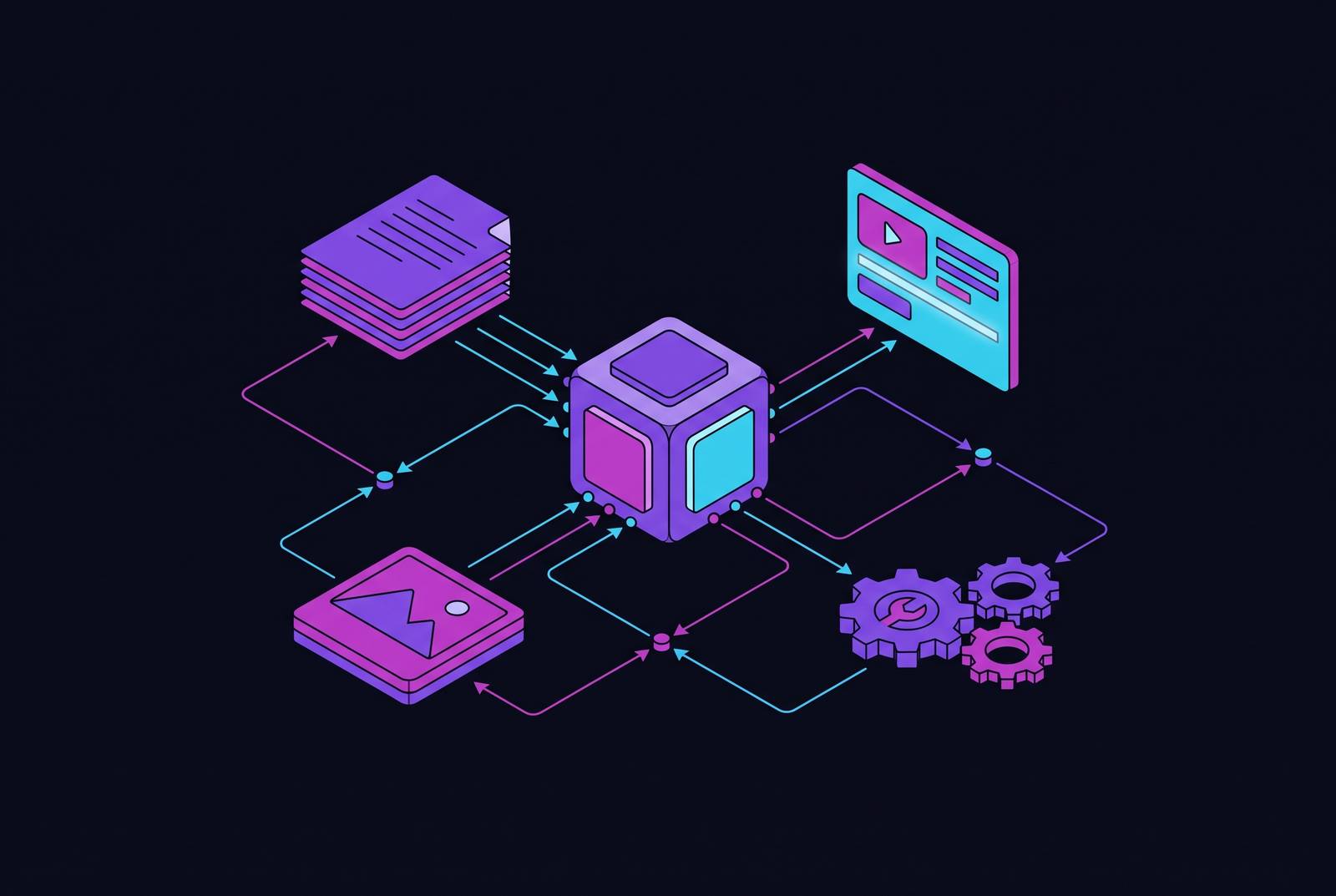
In the proposed setup, model kernels from different providers draft at the same time. A selection pass picks the best output line by line, and a final enhance pass gives the text one voice. The process above and below this layer remains unchanged, so the team does not acquire a separate manual rewriting stage. However, the relevant detection result belongs to the final enhanced draft.
Routing already provides a practical way to make these choices in enterprise deployments. A customer FAQ can use a small, fast model, while a contract review uses a large, capable one and sensitive data stays on a local model. Content generation adds watermark compliance as a routing criterion beside task complexity, cost, and latency. Multi-agent content architectures in use in 2026 also share work among researcher, writer, and editor agents. Assigning these roles to different models can extend an existing architecture.
Role diversity alone, however, is not a measurement of the final text’s statistical properties. A unified voice and a reduced detector score are separate requirements, and the supplied material contains no measured integration result proving that both have been achieved together. The stated KGW threshold of 4 provides a test boundary. Operationally, every capability should be reachable by an agent through an API. The brief should go in and the draft should come back through the interface the team already uses, with no extra steps to do by hand.
How to evaluate whether any multi-model approach is actually working
Evaluation begins with the same mechanism the watermark detector uses. A qualitative reading can establish that a passage sounds natural, but it cannot establish that a statistical signature is absent. For a KGW-family claim, the relevant test is a z-score against a real detector. Under the stated standard, a z-score below 4 is below the detection threshold, while a score above it flags the watermark. The number of words changed is not a substitute for that result.
The scope of the result matters as much as the score. A test against one KGW-family detector provides evidence about that detector’s target signature. Undisclosed implementation parameters also limit what third-party testing can establish about Claude output. A result below the threshold also cannot prove legal compliance, truthfulness, or that the provenance chain is intact.
The evaluation stack therefore needs three layers, which are detector performance, task quality, and voice consistency. The first uses the relevant z-score test, while the second uses WritingBench or an equivalent measure of the work the draft must perform. EQ-Bench Creative Writing uses Claude Sonnet as an LLM judge to assess narrative quality, emotional depth, prose style, and character voice on an Elo scale. Its writing comparison shows which writing the judge prefers, which helps assess marketing copy and long-form content but does not test for a watermark. The third layer applies a brand-voice rubric with measurable criteria such as Flesch-Kincaid readability.
All three layers must pass because success in one does not compensate for failure in another. Claims need specific numbers, named sources, and machine-verifiable proof of what they claim. Content teams should require that standard from integration tools just as they require evidence for published content.