API Integration Patterns for Multi-LLM Content Pipelines
Mixing models in pipelines can disperse watermark signatures better than editing alone.
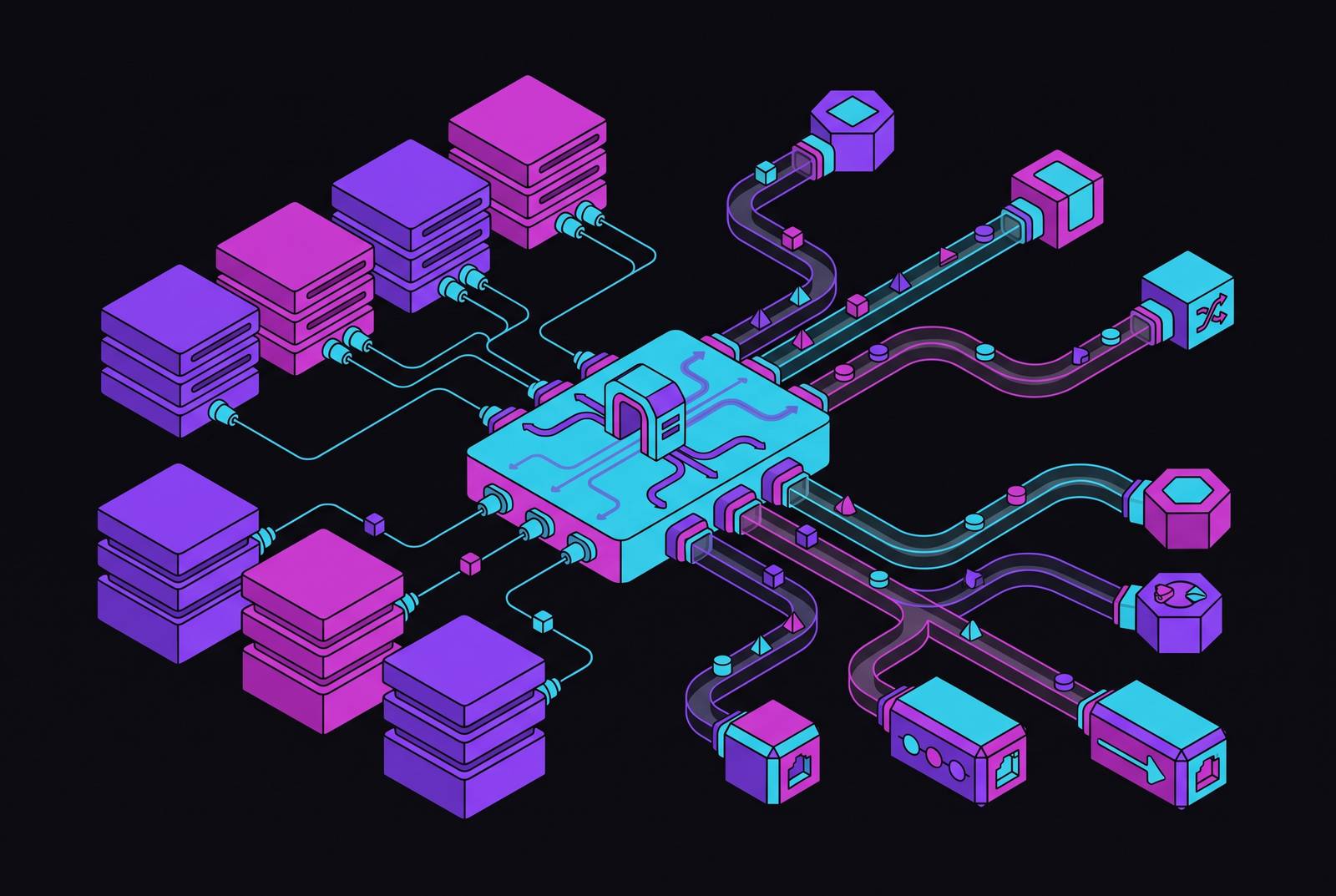
Multi-LLM content pipelines are an architectural choice. Ensembling, cascading, and parallel routing create different latency, cost, and provenance outcomes. How models contribute to the final text determines both operational behavior and the extent to which a single model’s statistical signature can dominate.
Why enterprises are adding an orchestration layer above their LLM APIs
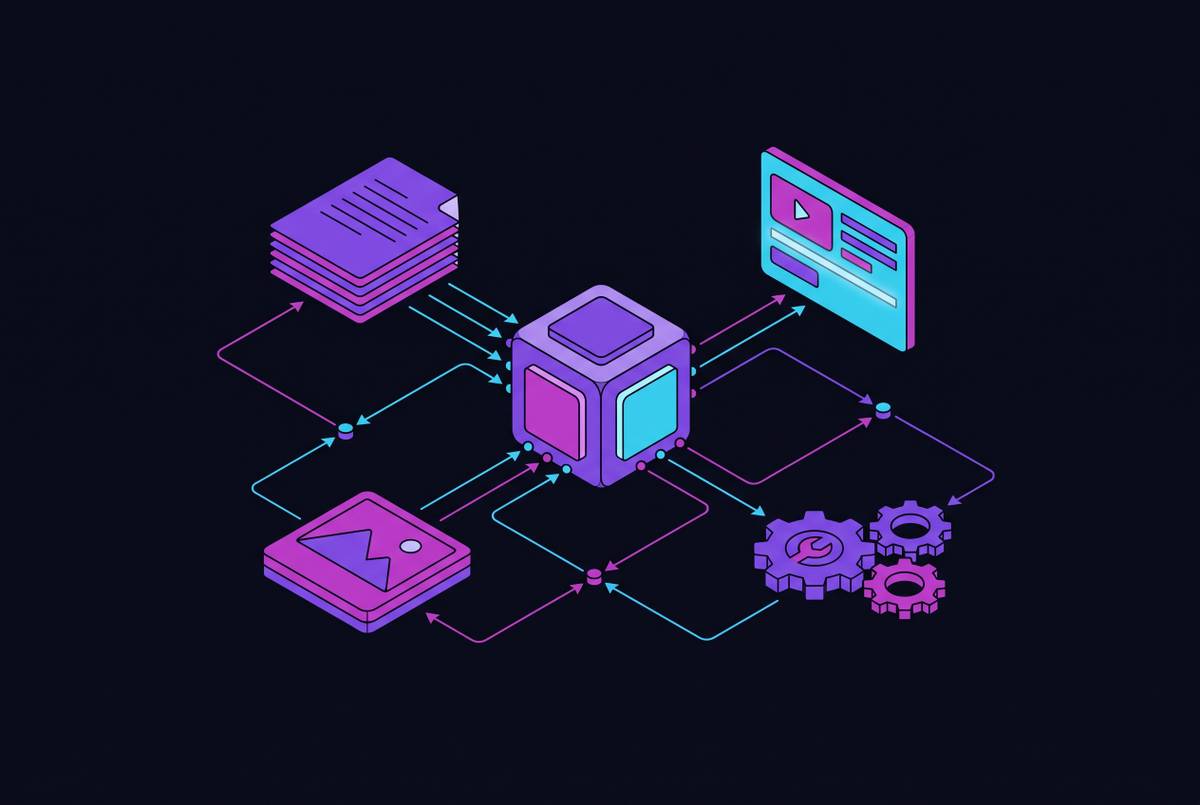
Using more than one provider creates problems in coordinating the work that one model endpoint cannot solve. Provider risk, latency variation, fragmented token spend, and compliance exposure extend across API boundaries. A successful request to one model does not resolve them. Enterprises therefore need a distinct orchestration layer that coordinates prompts, routing, retrieval, tools, agents, evaluations, guardrails, logs, and costs through a single controllable surface.
This layer has become an engineering category in its own right. LangChain, LangGraph, LlamaIndex, and Haystack provide open-source foundations, while commercial platforms include IBM watsonx. Their enterprise targets differ, spanning broad application development, stateful agents, and document pipelines. The framework choice is only part of the decision. More fundamentally, teams must decide how that layer distributes work among models and assembles their contributions into an output.
The three integration patterns: what ensembling, cascading, and parallel routing actually do
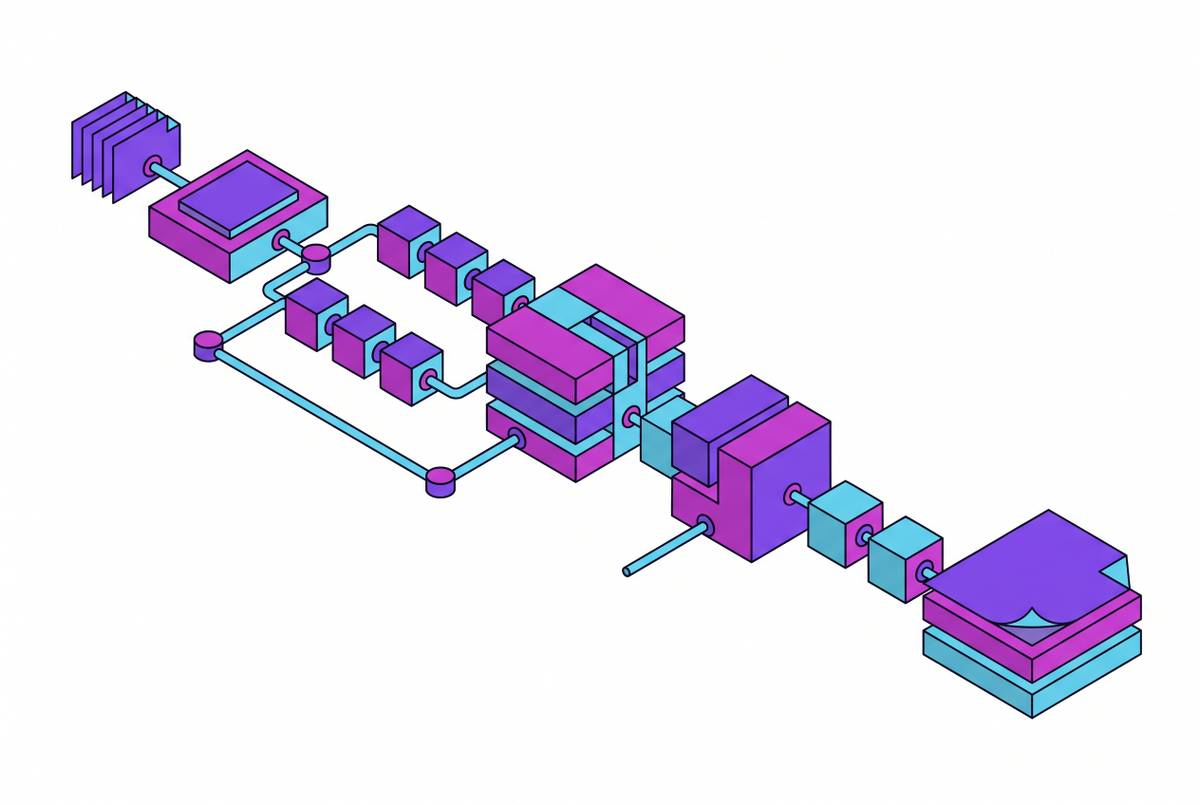
Ensembling sends the same input to several models in parallel, then aggregates their responses. Its schematic is a fan-out followed by a convergence point. Consensus supports accuracy or robustness.
Cascading arranges models in a sequence with conditional escalation. A smaller, faster model typically receives the request first, and a more capable model receives it only if the initial output is insufficient. Unlike an ensemble, a cascade does not require every model to process every request. Its structure is designed to reserve more demanding processing for requests that need it.
Parallel routing, also called cost-aware routing, places a meta-agent before the available pipeline configurations. That agent evaluates an incoming request and selects a configuration consistent with a user-specified cost-quality preference. The configuration it chooses can include an ensemble or cascade. Selection precedes the work and leaves subsequent aggregation in place. These patterns are therefore distinct, even when one production pipeline combines them.
How each pattern's structure drives different latency and cost outcomes
An ensemble incurs inference costs across its participating models, then adds aggregation overhead. The more models take part, the more compute they use. When aggregation waits for every response, the slowest model sets the waiting time before that step can finish. Asynchronous collection with a timeout changes that constraint, but it also changes which responses are available for aggregation.
A cascade instead front-loads the cheapest inference and incurs more expensive processing only for requests that escalate. This produces a favorable cost curve when most requests are simple enough to stop early. Uniformly complex workloads reverse the advantage. If nearly every request goes on to the more capable model, the first stage adds latency without saving as much as intended. The workload’s difficulty distribution is therefore central to the choice.
Cost-aware routing adds a different expense because the meta-agent has its own inference cost and latency. A poorly calibrated router can negate its intended savings. For teams implementing this pattern, the architectural recommendation is to keep routing logic in declarative metadata. Metadata-driven routing survives provider changes, while hardcoded rules create migration debt with API shifts. Request-level routing metadata also enables cost attribution to a team or project, connecting resource management to governance.
Why the architectural pattern — not editing or paraphrasing — determines whether output carries a detectable statistical signature
The same aggregation boundary also shapes statistical provenance. In KGW watermarking, a partition based on a secret key marks a green subset of tokens, and generation favors that subset. Detection tests whether the output has more green tokens than would be expected without that bias. No individual token proves the watermark’s presence. The evidence comes from an excess across the token population, which can remain detectable over a long document even with moderate watermark strength.
\[ z=\frac{G-\gamma T}{\sqrt{T\gamma(1-\gamma)}}. \]
Here, \(G\) is the count of green tokens found, \(T\) is the number of tokens tested, and \(\gamma\) is the share of green tokens expected without watermark bias. The threshold used here is \(z_0 = 4\), with output above it flagged as watermarked. Hong et al.’s signature filtering paper uses that threshold and shows a text moving from \(z = 1.63\) to \(z = 6.67\) after filtering.
A pipeline that generates its entire final output through one watermarked model exposes that output to one model’s green-token bias. Mixing contributions from models with different keys and partitions can disperse the evidence associated with any one key. The aggregation step is decisive, however. An ensemble that blends contributions differs from one that sends everything through a single final rewriter, whose watermark can replace the upstream signature. Cross-provider token-level mixing can support dispersion, but selecting one provider for an entire response does not itself provide it.
This statistical argument holds conditionally. Different keys do not by themselves prove that every tested output will remain below a detection threshold. Low-entropy and mixed-source settings further complicate the inference. Strong fixed watermark settings also come with a trade-off in quality, so a weaker signal may still be a watermark signal. Architecture changes the distribution being tested, while measurement establishes the result.
Why paraphrasing and post-hoc editing cannot substitute for architectural dispersion
Research shows that one round of expert-LLM paraphrasing substantially reduces detection rates across tested watermarkers. That is evidence of an evasion attack. If the paraphraser applies its own watermark, the rewrite can substitute one signature for another.
The Bias-Inversion Rewriting Attack formalizes a more targeted intervention. It applies a negative bias to a proxy green-token set during paraphrasing, with detection probability decaying exponentially in the square of the bias parameter, \(\delta^2\). Its dependency is restrictive. The paraphraser must approximate the original model’s secret green-list partition, which a content team does not possess. Pan et al.’s knowledge distillation paper likewise studies targeted paraphrasing and inference-time watermark neutralization, but the latter requires knowledge of watermark rules unavailable in a black-box deployment.
Detector development makes reliance on rewriting still less stable. The ICLR 2025 LIDet paper shows that a model fine-tuned on watermarked outputs can inherit a detectable watermark, demonstrating that the signal is not merely superficial wording. Hong et al.’s paper approaches the problem from the detection side. Its lightweight module removes tokens that disrupt the statistics before the z-test, which helps it detect watermarks in weak-signal and low-entropy settings. Editing may suppress today’s measurement without establishing resistance to the next detector.
What provenance traceability means at the pipeline level and why gateway logging is not enough
Statistical attribution and production traceability operate at different layers. The former tests text for evidence of a generation process, while the latter concerns the records needed to explain and govern that process. Neither substitutes for the other. A dispersed statistical signature does not remove labelling obligations, and a gateway request log does not by itself establish compliance. Architecture determines both the output distribution and the scope of the execution chain that can be attributed.
The EU AI Act requires AI-generated outputs to be marked in a machine-readable format detectable as artificially generated under Article 50, while Article 53 addresses GPAI training-data documentation and published summaries. China also has mandatory AI-content labelling requirements. The United States has no federal mandatory AI-generated content labelling law, though California and New York have enacted limited requirements. These obligations require more than a low detection score. Gateway-only logging cannot stand in for the marking, documentation, and traceability required by the applicable regime.
The Corporate Monitor case provides a concrete governance example. A major Korean conglomerate’s production-scale study ran from Sep 2025–Feb 2026, coupling retrieval, clustering, and report generation with ensemble quality governance using large language models as evaluators. Its evaluator selection prioritized architectural diversity across at least two distinct architecture families to address single-model epistemic bias. Governance at the assessment stage becomes especially important when several components contribute to a report.
Model lineage adds another layer of attribution. Architecture configuration, tokenizer overlap, and embedding-space similarity measured through Linear CKA can support estimates of model derivation, although Linear CKA alone is not conclusive. Output tracing addresses a different object. The LLMTrace family supports dataset detection, reasoning-trace analysis, provenance attribution, and fine-grained AI-text localization. AgentOps and AgentTrace provide foundations for recording agent executions, while PaperTrail decomposes answers and source documents into claims and evidence units.
Designing a multi-LLM pipeline that is provenance-resistant by construction
For teams pursuing architectural dispersion, the design objective is to prevent one model’s token distribution from dominating the final output. This is narrower than making provenance unknowable. The pipeline still needs the required labels, execution records, and source attribution. Resistance to a single-model statistical signature should therefore be treated as a measurable property of aggregation.
A judge panel selecting tokens or lines from parallel outputs can distribute authorship across those models, whereas a single final enhancement pass reintroduces the rewriter’s distribution. That distinction belongs in the design itself. A cascade that ends with one model generating the output does not gain statistical dispersion just because other models worked on earlier drafts. A routing layer also fails to provide dispersion when each complete output still comes from one model.
Cross-provider blending gives independence a stronger basis than choosing several models from the same provider family. Same-provider models may share tokenizer structure and exhibit correlated partitions under shared key derivation. Distinct training stacks and tokenizers can reduce that dependency. However, provider diversity alone does not demonstrate below-threshold detection, because the claim depends on the actual watermark configurations and resulting output. The defensible design couples cross-provider mixing with detector-based evaluation rather than assuming that model count proves resistance.
Voice consistency must be handled without undoing that structure. The recommended approach is taxonomy-as-data, with an immutably versioned style guide pinned to each result and strict output contracts that prevent categories outside the guide. This constrains the contributions before final assembly. It provides a basis for unified voice across the authorship pool without relying on a single-model rewrite to normalize everything afterward. Style governance and statistical dispersion can then be evaluated as separate requirements.
Evaluating multi-LLM pipeline quality: the layered framework that benchmarks alone cannot provide
Evaluation must cover what the models contribute and the aggregation steps as well as the finished article. Otherwise, a satisfactory final result can conceal weaknesses in the configuration that produced it. Benchmarks provide the first layer. They establish a baseline for consistency, accuracy, and tone compliance, while post-publication measures including impressions, click-through rate, average position, dwell time, and bounce rate address performance outside the benchmark setting. These measures answer different questions and should not be treated as interchangeable.
The evaluation layer also needs safeguards against single-model epistemic bias. The conglomerate case used large language models as evaluators from three distinct model families, making diversity a governance practice as well as a generation strategy. Assessment should not collapse to one model’s preferences. That principle connects operational quality control to the same architectural concern that motivates dispersed authorship, while leaving the actual quality judgment subject to measurement.
For the watermark claim specifically, the minimum standard is a documented z-score against a named KGW detection scheme. The relevant threshold here is \(z_0 = 4\). A score below it supports a limited conclusion about that output under that detector. The practical acceptance criterion is measured performance against the named test, with the pipeline’s traceability and labelling obligations evaluated separately.