Brief-to-Draft Pipeline Design for Multi-Model AI Writing
Multi-model pipelines disperse watermark signals, but they don't erase legal disclosure obligations.
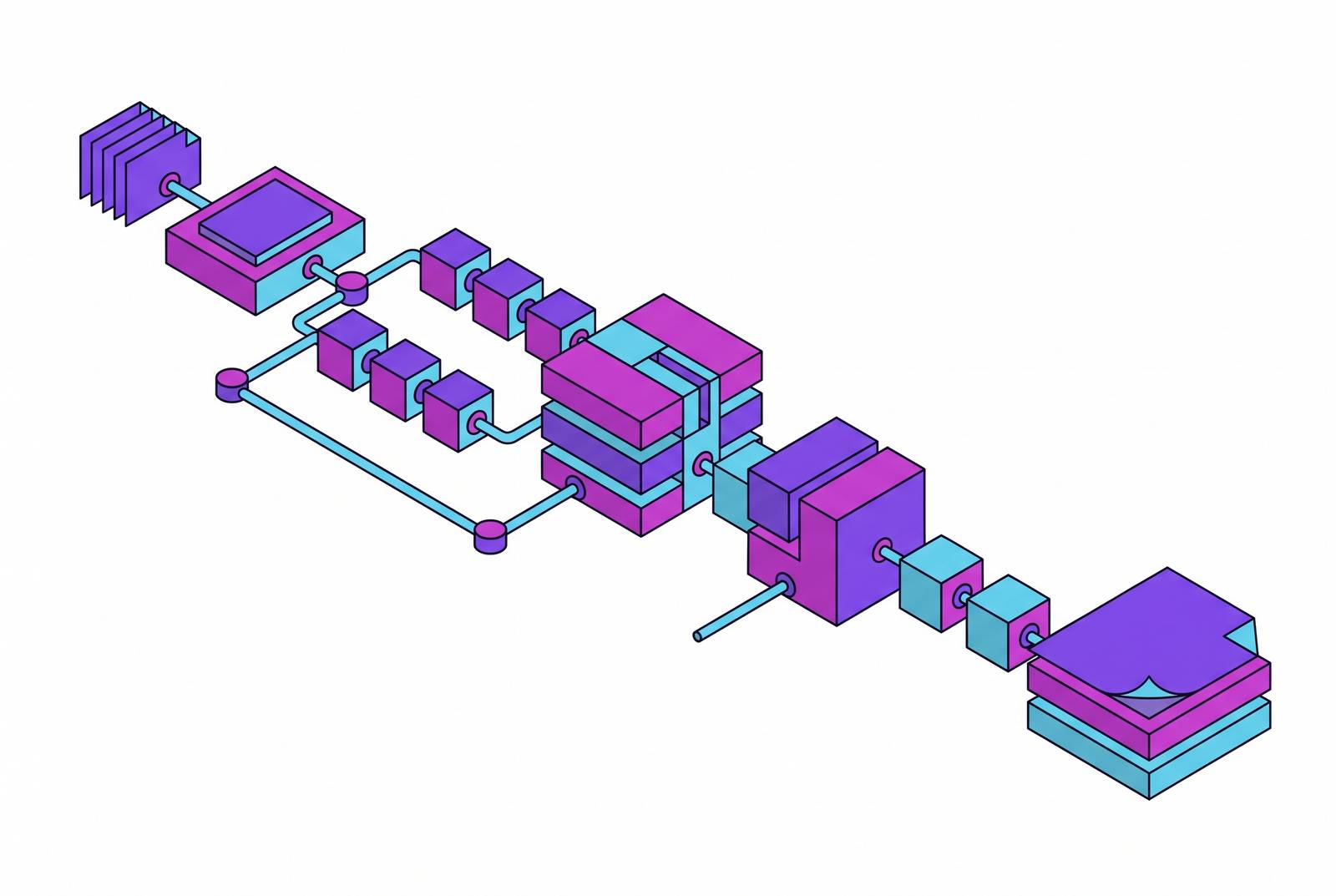
A brief-to-draft pipeline for multi-model AI writing can improve quality and disperse statistical authorship signals, but those outcomes are not the same as legal compliance. Control authorship at every stage, from brief ingestion through voice unification.
Why single-model pipelines produce a detectable statistical signature by construction
A KGW-family watermark operates in token selection. At each generation step, the system hashes preceding context and uses a secret key to divide the vocabulary into a green list and a red list. It then applies a logit bias toward green tokens. The text can read naturally and still have a green-token excess that can be measured.
A detector with the same secret key reconstructs the partitions from the text and counts green tokens. It then uses a one-proportion z-test to compare that count with its null expectation. If the excess persists, longer documents accumulate more evidence and produce a stronger detection signal. The roughly 300-token significance point described for this mechanism is conditional on the green-list share holding. The bias parameter δ also matters, because stronger bias improves detectability while weaker bias reduces the signal.
A pipeline that repeatedly uses the same watermarked generator therefore repeatedly exposes its output to the same statistical test. The mechanism itself allows the signal to diminish as δ approaches zero.
What the EU AI Act's Article 50 actually requires from content teams deploying AI
The European Commission states that Article 50 of the EU AI Act applies from August 2, 2026. Its transparency obligations apply to providers and deployers, so a content team must treat disclosure as its responsibility too. The relevant distinction is between a machine-readable provenance mark and information that people can perceive. One does not automatically satisfy an obligation to provide the other.
Under Article 50(4), deployers must disclose when AI-generated images, audio, or video make up a deepfake. That category concerns material resembling existing persons, objects, places, entities, or events that would falsely appear authentic or truthful. A machine-readable mark alone is not the human-visible disclosure described for this material. The European Commission’s FAQ also identifies AI-generated or manipulated text published on matters of public interest without human review or editorial control as subject to labeling. That text-related obligation applies to a specific subset of AI-assisted articles.
Text watermarking therefore belongs within a wider provenance and disclosure problem. Differences between providers’ watermarking choices can make traceability uneven across a multi-model workflow. Yet reducing traceability does not resolve that unevenness in a legal sense. Content teams need to build control over provenance into the whole pipeline and separately meet the disclosure duties that apply to them. A detector’s inability to identify a watermark is not evidence that those duties have been discharged.
Why surface-level editing and single-pass paraphrasing do not remove the statistical signal
Editing changes the visible text, but light editing can leave much of a watermarked token sequence intact. Correcting punctuation, adjusting word choices, and reworking a few sentences do not necessarily remove enough statistical evidence to defeat detection. Because KGW depends on preceding context, the effect is more complicated than counting unchanged words.
Jiacheng Liang et al.’s “Watermark under Fire: A Robustness Evaluation of LLM Watermarking,” published in Findings of EMNLP 2025, introduced WaterPark. The study reports that a single round of ChatGPT paraphrasing reduced detection rates for all tested watermarkers below 0.3. That finding demonstrates substantial weakening under the tested conditions. It does not establish that every paraphrased document becomes undetectable, or that detection performance transfers unchanged to another pipeline.
Full re-composition differs from editing because it discards the original token choices and generates a new draft. The team has also paid for a draft whose wording is no longer being used. The useful architectural inference is narrower and stronger than a promise of removal. If diverse authorship is the goal, it should be part of generation itself, rather than an uncertain correction applied after a single-model draft is complete.
How the brief-ingestion stage determines every downstream authorship property
Brief ingestion establishes the units of work that later stages can distribute. A monolithic prompt sent to one model gives that model control over the whole initial draft. Decomposing the brief instead creates bounded tasks that different models can execute independently. This does not itself determine the final watermark score, because later selection and rewriting still matter. Decomposition gives the pipeline a practical basis for distributed authorship.
A useful decomposition separates factual claims from tone constraints and identifies passages that require source fidelity. For example, extracting the claims that a section must preserve is a different task from drafting that section in the required voice. The drafting input can then carry those claims, its argument, and its stylistic constraints without repeating the entire brief. Routing by task type also permits factual extraction and voice matching to use different models. This makes decomposition both a production decision and a provenance decision.
The MAST taxonomy, accepted to the NeurIPS 2025 Datasets and Benchmarks Track, analyzed over a thousand annotated execution traces across seven frameworks. It attributed the large majority of failures to specification and coordination problems. That finding backs the need for clear task boundaries and gives no basis for assuming that more models will always improve results. Each drafting model should get an input with a clear scope that it can work from without reading another model’s draft. Independence begins with what the brief allows each model to know and do.
What parallel drafting across multiple models actually does to the token-level statistics
Models that draft on their own can produce candidate passages with different statistical signatures. In the KGW case described here, different secret keys split the green list into different partitions. A token favored under one key need not be favored under another. So a detector that uses one model’s key may find less green-token excess in a document with text from several models. The architecture can dilute a particular signal by changing the composition of the final sequence.
That mechanism does not establish that the combined signal must collapse to the null expectation. A model’s contribution can retain an excess under its own key even when other contributions do not. Whether the full document crosses a detection threshold depends on how much of that contribution survives, its watermark strength, and the length and context of the selected passages. Shorter contributions can still add up to enough text to matter. Authorship diversity therefore calls for measuring detection behavior.
The same distinction applies across providers, whose watermarking mechanisms need not share keys, vocabularies, or derivation rules. A result explained through KGW cannot simply be asserted for every text watermark. If one model drafts by rewriting another model’s output, the candidates no longer represent independent responses to the brief. Bounded parallel drafting creates genuine alternatives for the selection stage, while leaving their final statistical properties to be tested.
How line-level selection preserves the best content from each model without reintroducing a single-model fingerprint
Parallel generation only creates the possibility of multi-model authorship. If the next stage chooses one complete draft, the published document still comes from one generator. The unused alternatives have no effect on its token distribution. Line-level or sentence-level selection can retain contributions from several candidates.
A judge panel should use the same criteria to assess candidates no matter which model they come from. Those criteria include factual accuracy against the brief, adherence to tone and voice constraints, and lexical variety relative to adjacent selections. The panel’s job is to choose the strongest available wording within those constraints. Its selection decisions need not introduce a new text watermark, because those decisions are not themselves article prose. The article contains the selected candidates’ tokens.
That boundary matters when selection becomes synthesis. A judge that rewrites its chosen passages is also acting as a generator, so the statistical properties of its prose become relevant. Even a selection-only panel does not guarantee balanced authorship, since the strongest candidates may repeatedly come from one model. Sentence-level selection preserves the opportunity for dispersal without proving that sufficient dispersal occurred. Its defensible contribution is quality-controlled assembly, followed by evaluation of the assembled document.
How the voice-unification pass produces a single coherent voice without collapsing authorship diversity
Sentence-level assembly can expose differences in sentence length, transition phrasing, and hedging language. Each selected passage may be strong in isolation while the sequence sounds inconsistent. A final enhance pass addresses that problem by working on the joins between contributions. Its scope should be narrower than a fresh drafting pass, because the judge panel has already selected the substantive prose for quality.
Local revision and full regeneration replace different amounts of prose. Style changes necessarily can change tokens. Adjusting a paragraph opener or a transition alters the sequence, even when the factual content remains untouched. The architectural constraint is therefore to limit how much prose the enhancing model replaces. Regenerating full paragraphs or long passages would give that model a larger share of final authorship and could introduce its own watermark signal.
The final z-score provides a relevant technical gate where the applicable KGW detector and secret key are available. Comparing the completed text against the detector’s threshold can show whether that test flags the output after enhancement. A score below the threshold means that particular test did not detect a sufficient excess. Whether authorship diversity survived unchanged, another detector would agree, or the article satisfies Article 50 remains unproven. Voice review and watermark testing answer different questions, and neither can stand in for legal disclosure.
Why compliance by construction is structurally different from compliance by remediation
Compliance by construction means that the workflow incorporates the controls needed to meet an obligation before publication. Compliance by remediation means that the output needs to be corrected after the main production process is finished. The distinction is valuable, but only when the obligation is defined correctly.
For a team producing hundreds of articles, dependable structure is preferable to repeated attempts at uncertain cleanup. Brief decomposition establishes factual scope, the judge panel provides a quality gate, and the enhance pass maintains voice consistency. Those stages can also distribute authorship. However, no evidence presented here establishes that cross-provider dispersal makes a detection threshold unreachable for every possible output.
Teams can keep their existing briefs and outlines. The pipeline can take those inputs, share out the drafting work, choose candidate passages, and return a document with one voice for approval. Its quality controls should be built into the production architecture, and its provenance controls must cover the whole workflow.